
carol of the bells sheet music pdf piano
Carol of the Bells Sheet Music PDF Piano: A Comprehensive Guide
Discover a wealth of free and paid Carol of the Bells piano sheet music in PDF format, catering to all skill levels – from beginner to advanced pianists.
Explore arrangements by Julie A. Lind, Samuel Alexandre Rousseau, and Michael Kravchuk, readily available on platforms like PianoSongDownload.com and MuseScore.com.
Find easy, intermediate, and advanced versions, including fingerstyle tutorials, to master this beloved Ukrainian Christmas carol with ease and enjoyment.
Historical Background of Carol of the Bells
Carol of the Bells originates from a pre-Christian Slavic ceremonial chant, “Shchedryk,” meaning “generous.” This ancient Ukrainian folk song wasn’t initially associated with Christmas but with the New Year celebrations, symbolizing prosperity and good fortune. Families would walk from house to house, singing Shchedryk and receiving gifts in return – a tradition deeply rooted in Ukrainian culture.
The melody’s distinctive bell-like pattern imitates the ringing of church bells, a significant element in Ukrainian religious and cultural life. It’s a song of hope and renewal, traditionally sung during the winter solstice to usher in the new year and brighter days. The song’s enduring popularity stems from its captivating rhythm and the universal themes of joy and celebration it embodies.
Interestingly, the Western world’s association with Christmas came later, largely through the efforts of composer Mykola Leontovych, who arranged the folk tune into the version we recognize today. This arrangement, and its subsequent translation and adaptation, cemented its place as a beloved Christmas carol globally.
The Origins of the Ukrainian Bell Carol
“Shchedryk,” the original Ukrainian folk song, predates its association with Christmas, stemming from ancient pagan winter solstice traditions. The word itself signifies “generous” and was linked to wishes for prosperity and a bountiful harvest in the coming year. Villagers would go door-to-door, singing Shchedryk, receiving treats and gifts as a symbol of shared goodwill.
The song’s rhythmic structure and melodic contour intentionally mimic the sound of bells – a crucial element in Ukrainian culture, historically used for signaling, celebrations, and religious observances. This auditory imitation is central to the song’s identity and evocative power.
Unlike many Western Christmas carols with explicitly religious lyrics, Shchedryk’s original verses focused on themes of nature, fortune, and community. Its transformation into a Christmas carol occurred primarily through its adaptation and popularization in the West, showcasing the song’s adaptability and universal appeal.
Mykola Leontovych: Composer and Arrangement
Mykola Leontovych (1877-1921), a Ukrainian composer, is credited with creating the now-famous choral arrangement of Shchedryk, transforming a simple folk tune into a sophisticated and globally recognized masterpiece. He meticulously layered harmonies and vocal parts, building upon the original melody to create a richer, more complex soundscape.
Leontovych’s arrangement, completed in 1914, wasn’t a single, static creation; he revised it multiple times, refining the harmonies and vocal textures. This dedication to perfection resulted in a piece that beautifully captures the essence of Ukrainian folk music while possessing a universal appeal.
His work brought the song to international attention, particularly after its performance in the United States in 1921. The English lyrics, penned by Peter Wilhousky, further cemented its place as a beloved Christmas carol, forever linking Leontovych’s name to this iconic melody.
Availability of Sheet Music in PDF Format
Carol of the Bells sheet music in PDF format is remarkably accessible, catering to a wide range of pianists. Numerous websites offer free downloads, while others provide more elaborate, professionally arranged versions for purchase. The PDF format ensures easy portability and printing, allowing musicians to practice and perform the piece conveniently.
Popular platforms like MuseScore.com host a diverse collection of arrangements, from simple beginner versions to complex, advanced interpretations. PianoSongDownload.com specializes in piano arrangements, including those by Julie A. Lind, available in PDF format. These resources often provide options for different skill levels.
The prevalence of PDF sheet music makes learning and playing Carol of the Bells more attainable than ever, fostering a vibrant community of pianists enjoying this timeless classic.
Popular Websites Offering Free PDF Sheet Music
Several websites readily provide free PDF sheet music for Carol of the Bells, making it accessible to pianists of all levels. MuseScore.com stands out as a prominent resource, hosting numerous arrangements by various composers, including Samuel Alexandre Rousseau’s piano solo version. Users can download and print these scores in PDF or MIDI format.
PianoSongDownload.com, while offering paid arrangements, also features some free options and previews. Additionally, exploring online piano communities, such as discussions on Reddit’s r/piano, often reveals links to free sheet music shared by fellow musicians. These communities are invaluable for discovering hidden gems.
Remember to always check the usage rights and copyright information before utilizing any free sheet music found online, ensuring respectful and legal access to these musical resources.
PianoSongDownload.com: Arrangements and Copyright
PianoSongDownload.com offers a dedicated arrangement of Carol of the Bells by Julie A. Lind, specifically designed for piano solo. This arrangement is noted as being copyrighted in 2013, with indications for a “Moderately Fast” tempo and dynamic markings like pp (pianissimo) and mf (mezzo forte). The sheet music includes standard notation with measures and key signatures.
It’s crucial to understand that utilizing arrangements from this website, or any source, requires respecting copyright laws. While previews may be available, full access to the sheet music often necessitates a purchase. The copyright notice clearly states the ownership of the arrangement, protecting the composer’s intellectual property.
Always verify the licensing terms before distributing or performing any copyrighted material obtained from PianoSongDownload.com or similar platforms.
Sheet Music Difficulty Levels
Carol of the Bells sheet music is available across a broad spectrum of difficulty levels, catering to pianists of all abilities. Beginner arrangements simplify the melody and harmonies, often utilizing fewer chords and simpler rhythms, making it accessible for those new to the instrument. Intermediate versions introduce more complex chord progressions and rhythmic patterns, requiring a greater degree of technical proficiency.
Advanced arrangements, including fingerstyle tutorials, present the most challenging interpretations, demanding advanced technique, coordination, and musicality. Michael Kravchuk offers arrangements specifically categorized into Easy, Intermediate, and Advanced levels, providing a clear progression for learning.
Choosing the appropriate level is vital for a rewarding learning experience. Starting with an easier arrangement builds confidence and gradually introduces complexity.
Easy Piano Arrangements for Beginners
For aspiring pianists, several easy arrangements of “Carol of the Bells” provide a gentle introduction to this beautiful piece. These simplified versions typically feature a single-hand melody with basic chord accompaniment, minimizing complexity. MuseScore.com hosts a readily available “Carol of the Bells (easy piano)” sheet music, designed for beginners.
Michael Kravchuk also offers an “Easy” level arrangement, downloadable in PDF format, perfect for those just starting their piano journey. These arrangements prioritize readability and focus on the core melody, omitting intricate harmonies or complex rhythms.
Beginners can expect to encounter simple time signatures and key signatures, fostering a solid foundation in musical understanding. These accessible versions allow new players to quickly learn and enjoy playing this iconic carol.
Intermediate Piano Arrangements
Intermediate piano players seeking a more challenging rendition of “Carol of the Bells” will find numerous options available in PDF format. Michael Kravchuk provides an “Intermediate” level arrangement, building upon the foundational skills learned with easier versions. This version introduces more complex chord progressions and rhythmic patterns, demanding greater dexterity and musicality.
Arrangements at this level often incorporate both hands more actively, with the left hand providing richer harmonic support. Players can expect to encounter slightly more intricate notation and a fuller sound. Julie A. Lind’s arrangement on PianoSongDownload.com, while copyrighted, represents a popular choice for intermediate learners.
These arrangements strike a balance between accessibility and musical depth, allowing pianists to refine their technique and explore the carol’s harmonic richness.
Advanced Piano Arrangements & Fingerstyle Tutorials
For highly skilled pianists, advanced arrangements of “Carol of the Bells” offer a significant musical challenge. Michael Kravchuk also provides an “Advanced” level arrangement, demanding a high degree of technical proficiency and musical interpretation. These arrangements frequently feature complex harmonies, rapid passages, and intricate voicing.
Beyond traditional notation, explore fingerstyle tutorials and tabs, particularly those found alongside the easy and intermediate versions mentioned on Reddit’s r/piano forum. These resources allow pianists to recreate the carol’s iconic bell-like texture with a more intimate and nuanced approach.
Mastering these arrangements requires a strong understanding of piano technique, music theory, and a dedication to practice. The reward is a stunning and captivating performance of this timeless classic.
Specific Arrangements Available Online
Numerous arrangements of “Carol of the Bells” are readily accessible online in PDF format. Julie A. Lind’s arrangement, copyrighted 2013 and available on PianoSongDownload.com, is a popular choice, offering a moderately fast tempo and clear notation.
Samuel Alexandre Rousseau’s arrangement, found on MuseScore.com, provides another excellent option for piano soloists. Michael Kravchuk offers a comprehensive set of three arrangements – Easy, Intermediate, and Advanced – catering to diverse skill levels. These are also available as free piano arrangement sheet music.
MuseScore.com also hosts arrangements by other composers, such as OrliaAnn’s version of “Carols of the Bells” by Mykola Leontovych. These varied options ensure pianists can find a suitable arrangement to match their abilities and preferences.
Julie A. Lind Arrangement (PianoSongDownload.com)
Julie A. Lind’s arrangement of “Carol of the Bells,” available through PianoSongDownload.com, is a frequently sought-after resource for pianists. Copyrighted in 2013, this arrangement is specifically designed for piano solo performance and is noted for its clarity and accessibility.
The sheet music indicates a “Moderately Fast” tempo (pp), encouraging a dynamic and expressive interpretation. The arrangement features clear musical notation, making it relatively easy to follow, even for intermediate players. It includes standard piano notation symbols and is presented in a well-formatted PDF.
PianoSongDownload.com provides this arrangement as a downloadable PDF, allowing for convenient access and printing. It’s a popular choice due to its balance of musicality and playability, making it suitable for both practice and performance.
Samuel Alexandre Rousseau Arrangement (MuseScore.com)
Samuel Alexandre Rousseau’s arrangement of “Carol of the Bells” is readily accessible on MuseScore.com, a popular platform for free sheet music. This arrangement, created by Rousseau and arranged for piano solo by nativielmas09, offers a different interpretation of the classic carol.
Available in both PDF and MIDI formats, it provides flexibility for pianists who prefer different methods of learning and practice. The arrangement is generally considered to be of intermediate difficulty, requiring a reasonable level of piano proficiency.
MuseScore.com allows users to download and print the sheet music at no cost, making it a valuable resource for musicians on a budget. The notation is clear and well-presented, facilitating a smooth learning process. This version is a great option for those seeking a free, quality arrangement.
Michael Kravchuk Arrangement: Three Levels
Michael Kravchuk provides a comprehensive set of piano arrangements for “Carol of the Bells,” thoughtfully designed to accommodate pianists of varying skill levels. His offering stands out by presenting the piece in three distinct difficulty tiers: Easy, Intermediate, and Advanced.
This tiered approach allows beginners to approach the carol with a simplified version, gradually building their skills before tackling more complex arrangements. The Intermediate level offers a more challenging, yet still accessible, rendition, while the Advanced version caters to experienced pianists seeking a demanding performance piece.
Each level is available as a downloadable PDF, providing convenient access to the sheet music. Kravchuk’s arrangements are praised for their clarity and musicality, making them a popular choice for both learning and performance. This is a fantastic resource for progressive skill development.
Reading and Understanding Piano Sheet Music
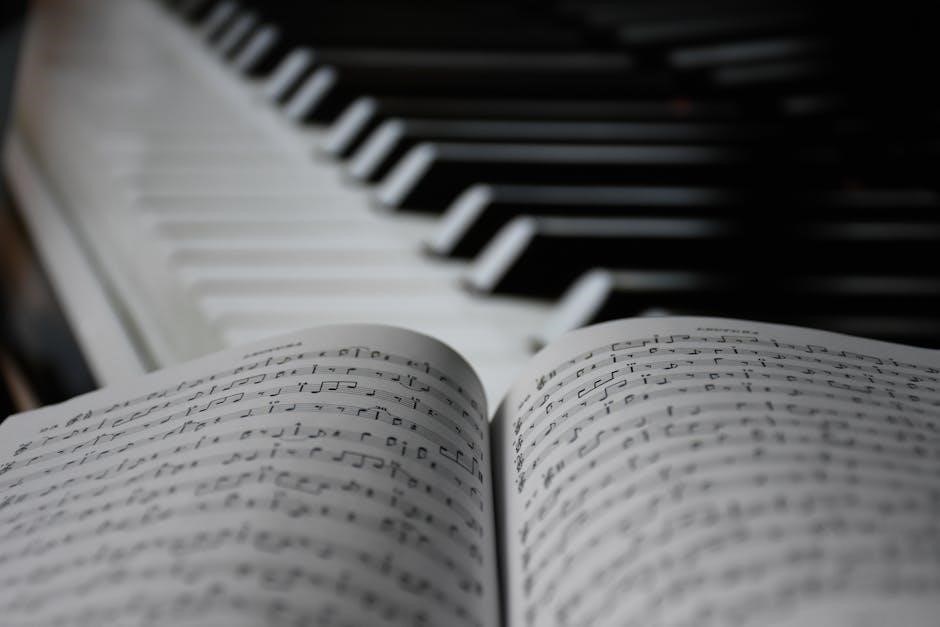
Decoding piano sheet music is fundamental to learning “Carol of the Bells” or any piano piece. Understanding key signatures is crucial; the carol’s sheet music will indicate sharps or flats, defining the tonal center. Time signatures, typically indicated as fractions, reveal the rhythm and beat structure – common signatures include 4/4 or 3/4.

Piano notation symbols represent pitch, duration, and dynamics. Notes on the staff correspond to specific keys on the piano. Stem length and flags indicate note values (whole, half, quarter, etc.). Dynamic markings (p for piano – soft, f for forte – loud) guide expressive playing.
Familiarize yourself with ledger lines for notes outside the standard staff range. Practice sight-reading to improve fluency. Recognizing these elements unlocks the musical language, enabling you to accurately interpret and perform “Carol of the Bells” from any PDF sheet music source.
Key Signatures and Time Signatures in Carol of the Bells
Analyzing the key signature in “Carol of the Bells” sheet music reveals the harmonic foundation of the piece. While arrangements may vary, many versions are in D minor, indicated by one flat in the key signature. This flat affects B, lowering it to Bb throughout the piece, influencing the overall tonality.
The time signature commonly found is 3/4, signifying three beats per measure, with a quarter note receiving one beat. This creates the characteristic rhythmic feel of the carol, lending itself to a waltz-like or lilting quality. Some arrangements might experiment with variations, but 3/4 is prevalent.
Understanding these signatures is vital for accurate rhythm and pitch. Recognizing the flat in D minor and counting in groups of three will significantly aid in learning and performing “Carol of the Bells” from any PDF sheet music.
Decoding Piano Notation Symbols
Piano sheet music for “Carol of the Bells” utilizes standard musical notation. Recognizing symbols is crucial for accurate interpretation. ‘p’ denotes piano, meaning soft dynamics, while ‘f’ indicates forte, or loud; ‘mf’ represents mezzo forte, a moderately loud volume.
Note values – whole, half, quarter, and eighth notes – dictate duration. Beams connect eighth notes, grouping them rhythmically. Slurs indicate legato phrasing, connecting notes smoothly. Staccato dots above or below notes signify short, detached sounds.
Accidentals – sharps (#), flats (♭), and naturals (♮) – alter pitch. Pay attention to repeat signs and codas, directing you through sections. Understanding these symbols unlocks the musical language of “Carol of the Bells,” enabling expressive performance from your PDF sheet music.
Downloading and Printing Sheet Music
Downloading “Carol of the Bells” piano sheet music in PDF format is straightforward from sites like PianoSongDownload.com and MuseScore.com. Ensure a stable internet connection for a complete download. Preview the PDF before downloading to confirm the arrangement suits your skill level.
Printing requires a PDF reader like Adobe Acrobat Reader. Select “Print” and adjust settings for optimal quality. Choose “Fit to Page” to avoid cropping notes. Use standard 8.5 x 11-inch paper for clear readability. A higher DPI setting enhances print clarity.

Test print a single page to verify layout and legibility before printing the entire score. Proper printing ensures a usable, easily readable copy for practice and performance of this beautiful carol.
Ensuring PDF Compatibility and Print Quality
PDF compatibility is crucial for seamless access to your “Carol of the Bells” sheet music. Most modern devices support PDF, but ensure your PDF reader (like Adobe Acrobat Reader) is up-to-date. This guarantees proper rendering of musical notation and symbols.
Print quality significantly impacts readability. Select a high-resolution printer and choose appropriate paper – standard printer paper works, but heavier stock enhances durability. Adjust printer settings for optimal contrast and sharpness. Avoid draft mode, as it can result in faint notes.
Check for any printing artifacts or distortions on a test page. If issues persist, experiment with different printer settings or consider printing at a local print shop for professional results. A clear, legible score is essential for effective learning and performance.
Legal Considerations Regarding Copyrighted Sheet Music
Copyright law protects musical compositions and arrangements. Downloading or distributing copyrighted “Carol of the Bells” sheet music without permission is illegal. Many free PDFs online may infringe on copyright, so exercise caution.
PianoSongDownload.com explicitly states copyright for its arrangements (© 2013). Using these without a license is a violation. Websites like MuseScore.com offer both copyrighted and public domain scores; always verify the licensing terms before use.
Respecting composers’ and arrangers’ rights supports the creation of new music. Consider purchasing sheet music from reputable sources to ensure fair compensation. Public domain versions are freely available, but confirm their status before use.

Be aware that even modifying and redistributing copyrighted material can be unlawful. Prioritize legal and ethical access to sheet music for a guilt-free musical experience;
Resources for Learning to Play Carol of the Bells
Numerous online resources can aid in mastering “Carol of the Bells” on piano. YouTube hosts countless tutorials, ranging from beginner-friendly walkthroughs to advanced performance guides. Explore channels specializing in piano instruction for detailed lessons.
Reddit’s r/piano community is a valuable hub for discussions, sheet music sharing (with copyright considerations!), and seeking advice from fellow pianists. Users frequently share arrangements and offer learning tips.
Online piano learning platforms like Flowkey or Skoove offer interactive lessons specifically for “Carol of the Bells,” providing feedback and progress tracking. Websites offering sheet music, such as MuseScore and PianoSongDownload, often have community forums for support.
Consider supplementing self-study with a qualified piano teacher for personalized guidance and technique refinement.

Online Piano Tutorials and Lessons
YouTube is a treasure trove of “Carol of the Bells” piano tutorials. Search for variations like “easy piano tutorial,” “intermediate,” or “fingerstyle” to find lessons matching your skill level. Many instructors offer step-by-step guidance, breaking down complex passages into manageable sections.
Flowkey and Skoove are interactive platforms offering dedicated “Carol of the Bells” courses. These platforms listen to your playing and provide real-time feedback, helping you improve accuracy and timing. They often include sheet music integration.
Websites like Hoffman Academy provide free piano lessons covering fundamental techniques applicable to learning “Carol of the Bells.” Consider supplementing these with song-specific tutorials for a comprehensive approach.
Look for tutorials focusing on specific sections or challenges within the piece, such as the intricate bell-like patterns.
Reddit r/piano Discussions and Resources
The r/piano subreddit is a vibrant community where pianists of all levels share resources and seek advice. Searching within r/piano for “Carol of the Bells” reveals discussions on arrangements, difficulty levels, and performance tips.
Users frequently share links to free sheet music, including advanced arrangements, as noted in a recent post regarding a free advanced piano arrangement. This is a great place to discover lesser-known versions.
Engage in discussions to ask questions about specific passages or techniques. Experienced pianists often offer helpful insights and alternative fingerings.
Browse past threads for recommendations on tutorials and learning resources. The subreddit also serves as a platform for sharing performances and receiving constructive criticism.
Be mindful of copyright when sharing or requesting sheet music, and always respect the rights of composers and arrangers.

Leave a Reply
You must be logged in to post a comment.